Shipping bags to a retailer and shipping bags to an Amazon fulfilment centre are two different jobs. The retailer accepts a carton and puts the product on a shelf. Amazon scans, stores and picks every single unit, and it charges you when the unit arrives in a state its system cannot handle.
Those charges have a name: unplanned preparation fees. They are charged per unit, they appear weeks after the shipment, and they are almost always avoidable at the factory stage. Here is what Amazon actually requires for bags, what we do at the packing table, and what we need from you to get it right the first time.
What Amazon requires for a bag
1. A poly bag, with a suffocation warning
Any bag that could be opened to a width of five inches or more has to be sealed in a poly bag, and the bag needs a suffocation warning printed on it. This is not a suggestion: the warning wording is specified, and a missing warning is one of the most common reasons for a prep charge.
Two details that catch people out:
- The bag has to be transparent, or large enough that the barcode can be read without opening it.
- The bag has to be sealed. A bag that is folded over and taped counts as sealed; a bag that is simply slipped over the product does not.
2. An FNSKU label, not your UPC
Amazon identifies your product by its FNSKU, not by the UPC you bought from GS1. The FNSKU has to be on each individual unit, and it has to be scannable without opening the poly bag.
The rule that causes most of the trouble is the second half of it: every other barcode must be covered or removed. If your bag carries a UPC on the hang tag and an FNSKU on the poly bag, the scanner can read the wrong one, the unit gets received as a different product, and you spend a week fixing an inventory discrepancy.
In practice we do one of two things: apply the FNSKU directly over the UPC, or print the hang tag without a barcode and put the FNSKU on the bag. Which one is right depends on whether you also sell the same product outside Amazon, where you need that UPC visible.
3. Correct carton limits
- Standard cartons must not exceed 25 inches on any side, unless the product itself is longer.
- Carton weight limits are 50 lb (22.6 kg) in the US and 23 kg in the EU. We keep export cartons within the limit your marketplace specifies.
- Every carton needs its own shipment label, and if the shipment has more than one carton you need the box content information – either uploaded to Seller Central or supplied as box content labels.
- Cartons must not be overfilled, and they must not be able to collapse when stacked. We use five-ply corrugated for anything going to a fulfilment centre, and we drop-test on request.
4. Sets, bundles and case packs
If two bags are sold as one listing, the set has to be marked “Sold as set” and sealed together. If your listing is case-packed, the units do not need individual FNSKU labels – but the carton does, and the quantity has to match the listing exactly. Telling us which model you use at the quotation stage avoids repacking later.
What happens at our packing table
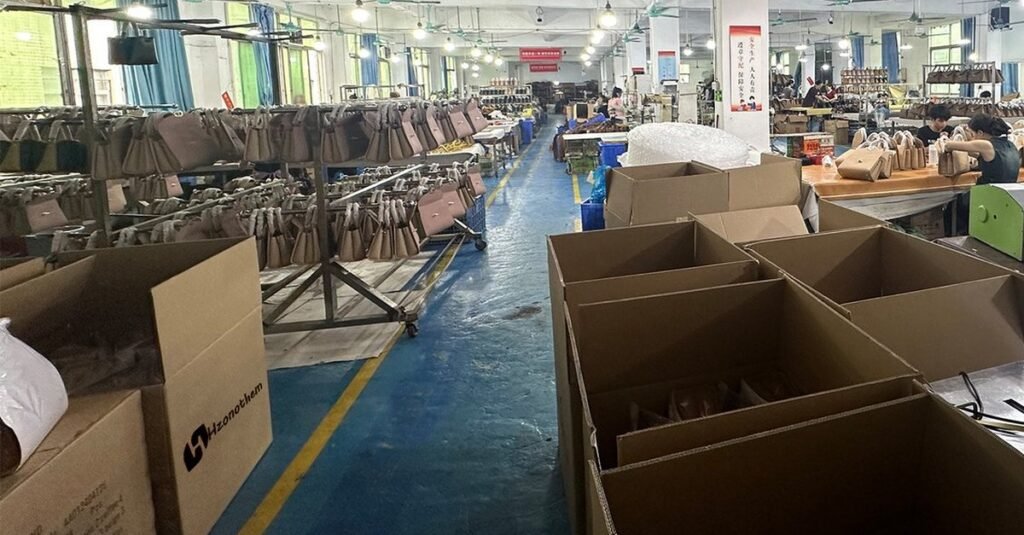
We do this for marketplace sellers every month, so it is a routine part of the order rather than a special request. For an Amazon-bound order we can:
- Bag each unit in PE or OPP with the suffocation warning printed on the bag
- Apply your FNSKU labels at the position you specify, over the UPC if that is what you need
- Supply and attach hang tags, including tags without barcodes
- Print and apply carton labels, and prepare the box content data
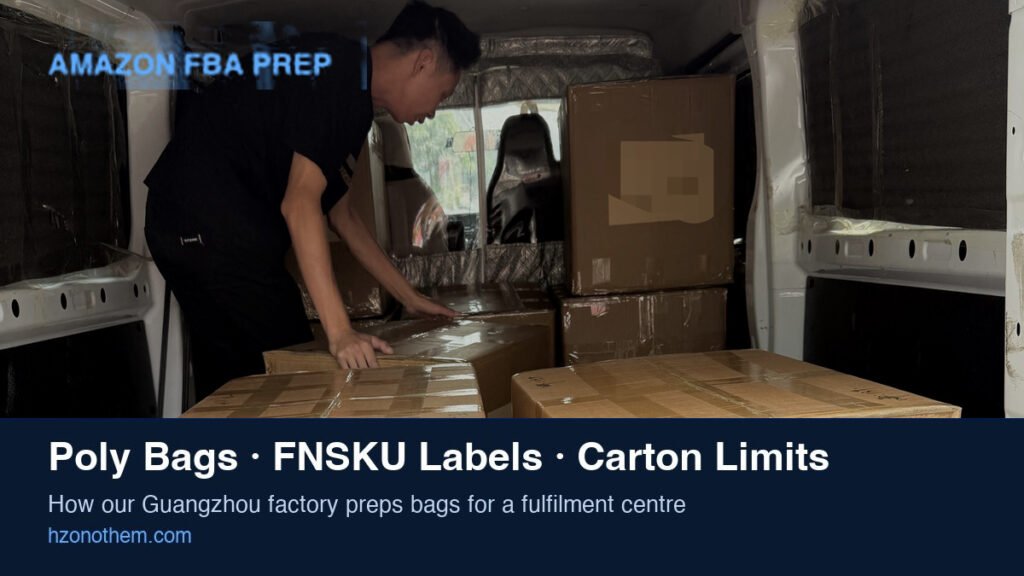
- Pack by SKU so that one carton holds one SKU wherever the quantity allows
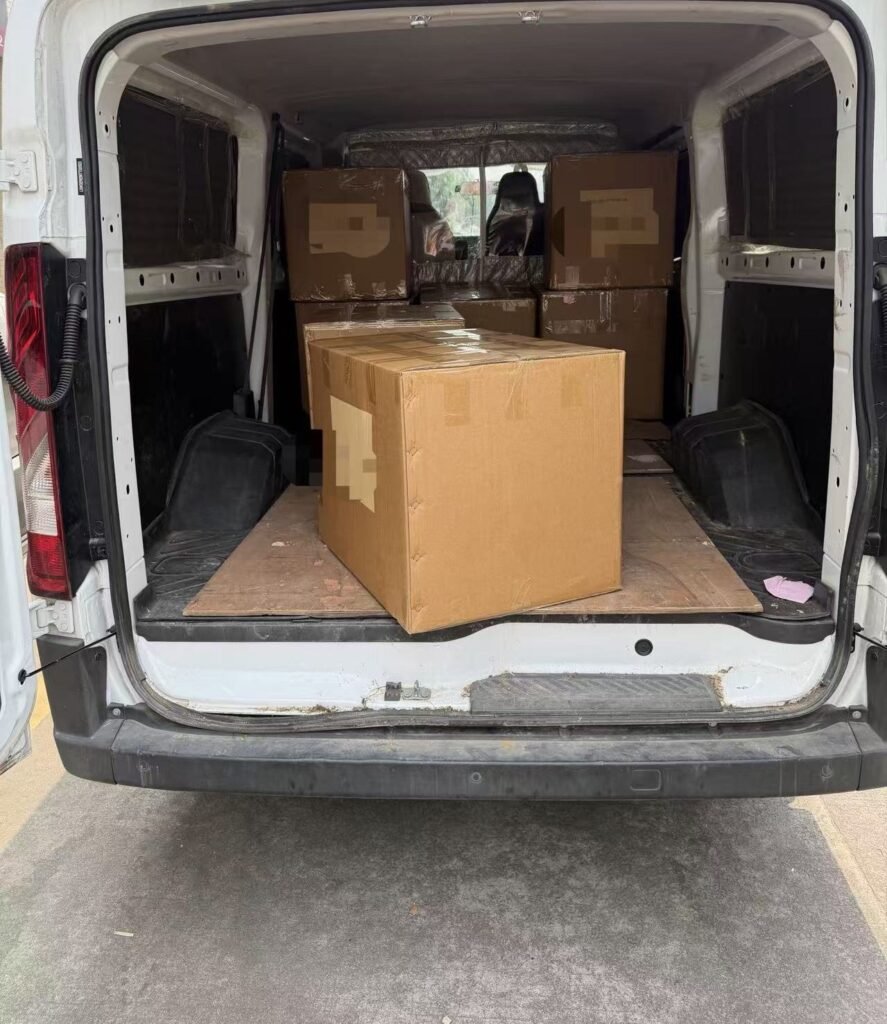
- Send photos of the packed carton before it is sealed, so you can check a sample against your own spec
Two things to know about timing. Labelling and bagging add roughly two to three days to the schedule, because it happens after the bags are finished and inspected. And label stock costs money: FNSKU labels are printed on your behalf, so the cost appears in the quotation rather than being absorbed silently. Ask for it to be itemised and it will be.
What we need from you
- Your FNSKU label file (PDF) downloaded from Seller Central
- Where the label goes: on the poly bag, on the hang tag, or over the UPC
- Whether the listing is individual, sold as a set, or case-packed
- Carton limits for your marketplace (US or EU) and the maximum carton weight you accept
- Suffocation warning wording, if you have a preferred version
- Whether the same product is also sold outside Amazon, so we know if the UPC must stay visible
Send these with your quantity and we will quote the packing as a line item, not as a surprise.
Four mistakes we see most often
- A poly bag with no suffocation warning. The bag is there, the warning is not – it still counts as unprepared.
- Two barcodes on one unit. The UPC on the hang tag and the FNSKU on the bag fight each other at the receiving desk.
- Cartons over the weight limit. Amazon reweighs and re-labels, and you pay for it. We keep to the limit you give us – so give us one.
- Box content information sent after the shipment arrives. It has to be in Seller Central before the carton is received, not after you get the discrepancy email.
Frequently asked questions
Can you apply FNSKU labels for us, or do we have to do it ourselves?
We apply them. Send the PDF from Seller Central and tell us the position; we print and apply during packing, and the labelled unit is included in your pre-production sample so you approve the finished article.
Do you charge for labelling?
Label stock and labour are quoted as a separate line, so you can see what it costs and decide whether to prep in your own warehouse instead. Many sellers start by prepping themselves and move it to us once volumes justify it.
Does bagging in poly bags delay the order?
It adds roughly two to three days, because bagging and labelling happen after the final inspection. If your launch date is tight, tell us at the quotation stage – the difference between a retail shipment and an Amazon shipment is much easier to build in than to add afterwards.
What about the carton labelling?
We print and apply the shipment and box content labels where you provide the files, and we keep one SKU per carton wherever quantities allow. For what happens before the carton is sealed, our QC checklist explains the inspection steps.
Getting it right at order stage costs nothing
Every item on the list above is a decision you make once, before sampling, and then it is fixed for every future order in that style. Leaving it until the shipment is on the water is what turns a good order into a prep-fee invoice.
Send us your FNSKU file, the label position and your carton limits together with your quantity and target price – we will come back with a quotation that includes the packing as a visible line. For the label and compliance side of the same order, see our guide to bag labeling and packaging requirements for US and EU retailers, and for how packing fits into the wider production calendar, bag manufacturing lead times.
We manufacture for marketplace sellers and brand owners under private label from 50 pieces per style, in backpacks, briefcases, totes, crossbody bags and waist packs. Start from the complete buyer’s guide to sourcing bags from China, or send us the details here.