Labels and packaging are the last thing anyone thinks about when a bag is designed, and the first thing that stops a shipment at the warehouse door. A missing country of origin, a synthetic bag described as leather, or a barcode in the wrong place means re-labelling, chargebacks, or stock that cannot be sold.
Most buyers raise this two weeks before shipping. That is late, and it is expensive. Here is what US and EU channels actually require, what we can do at the factory, and what we need from you to get it right on the first carton.
What has to be on the product itself
Country of origin
Imported goods entering the United States must be marked with their country of origin. The marking has to be legible, conspicuous and reasonably permanent, so for a bag that normally means a sewn-in label inside the main compartment, sometimes supported by a hang tag. “Made in China” is the standard wording.
In the EU the origin is expected on the product or its packaging, and since December 2024 a second set of contact details is required as well. We cover that under GPSR below.
Material content, and the mistake that costs the most
Materials have to be described accurately. This is where suppliers get careless, and it is the label error that causes the most damage:
- Genuine leather only for real animal hide. If you need to be precise on the label, specify the layer: full-grain, top-grain or split.
- Microfiber and synthetic materials must be described as polyurethane (PU), synthetic leather, or microfiber. Never simply as “leather”.
A bag made from microfiber leather with a “genuine leather” label is a misdescription. Customs authorities and retailers both treat it as one, and the retailer will charge the cost back to whoever supplied the label. If you sell genuine leather and microfiber side by side, the labels have to be different, and the production line has to keep them that way. We keep separate label stock per style for exactly this reason.
Care instructions
Care labelling is mandatory for apparel in the United States, not for bags, but most US retailers require it anyway because their returns teams ask for it. Keep the wording short and put it on the same label as the material: wipe with a soft dry cloth, keep away from prolonged moisture and direct heat, condition leather once or twice a year.
Brand, style number and barcode
Most channels need a scannable UPC or EAN, either on the product or on the hang tag, and it has to match the number in your listing. Place it where it will not be rubbed off by the bag itself in transit.
United States: what your retailer will ask for
- Country of origin marking is mandatory on imported articles. This is not optional and it is checked.
- California Proposition 65. If your bags are sold in California, your importer decides whether a warning is required. In bag production the usual risk points are lead in metal hardware, phthalates in PVC trim and coatings, and occasionally formaldehyde in textile finishes. The warning wording is the importer’s call, legally; we produce the label to your artwork and can arrange the testing that supports it.
- Retailer compliance manuals. Large US retailers publish their own label specifications: label position, font size, hang-tag dimensions, barcode placement. Send us the PDF and we implement it. Do not send us a photo of a competitor’s bag and ask for “the same” — the spec usually differs by a few millimetres that matter.
- Amazon. FNSKU label instead of your UPC on the unit, poly bag with a suffocation warning, and carton-level prep rules. That is a separate subject and we cover it in our Amazon FBA packaging guide.
European Union: what changed in December 2024
GPSR and the responsible person
The General Product Safety Regulation (EU 2023/988) applies from 13 December 2024 and covers non-food consumer products, bags included. Two requirements matter to you as a buyer:
- Every product placed on the EU market needs a responsible person established in the EU — normally your importer, or an authorised representative you appoint in writing.
- The responsible person’s name, postal address, email and phone number must appear on the product, on its packaging, or on an accompanying document.
Products also need to be identifiable (type, batch or serial number) together with the manufacturer’s name and address. In practice your EU customer will ask us for the manufacturer details, the model and batch numbering, and the technical documentation behind the product. We can supply all of that. What we cannot do is invent the responsible person’s details — those have to come from you, because they carry the legal responsibility.
REACH: chromium VI, azo dyes, SVHC
REACH is the reason European buyers ask for test reports before they place a bulk order, and for leather goods the first question is almost always chromium VI:
- Chromium VI in leather: leather articles that come into contact with the skin must not be placed on the EU market at 3 mg/kg or more of the leather’s total dry weight (REACH Annex XVII, entry 47). The same limit applies in Great Britain under UK REACH.
- Azo dyes and restricted substances in dyed textiles and leather, tested against the standard entry list.
- SVHC in components above 0.1% by weight, which in bags usually means hardware alloys and adhesives.
We test hides, hardware and finished goods at third-party laboratories such as SGS, BV or Intertek. The testing can be booked on your account or ours, and we will tell you the cost and the lead time before we start, because it adds days to the schedule. If your retailer already has an approved test protocol, send it and we will use theirs.
Bags do not need CE marking
Buyers regularly ask whether our bags are “CE certified”. Bags are not covered by any CE directive. The EU safety obligation on bags comes from GPSR and REACH, not from CE marking. If a supplier offers to “CE certify” your handbags, ask them which directive applies — the answer will tell you how much they know about compliance.
Germany: packaging weight data
German customers will ask for the material and weight of every packaging component: carton, poly bag, hang tag, tissue paper, dust bag. They have to register and license their packaging under the German packaging rules, and the fee is calculated by weight and material. We can supply a packaging weight breakdown per component with the quotation — ask for it and it costs nothing. It saves your customer a week later.
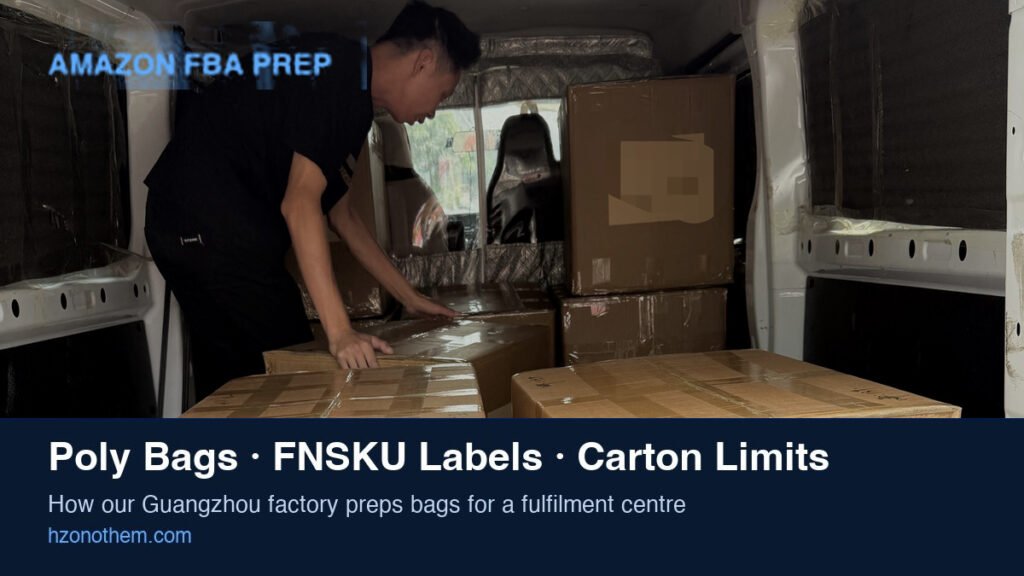
If the order is going to an Amazon fulfilment centre, the packaging rules change: our guide to Amazon FBA bag packaging, poly bags and FNSKU labels covers what the fulfilment centre requires on the bag, the label and the carton.
What we need from you before production starts
- Logo files and their positions, with size in millimetres
- Country of origin wording (normally “Made in China”)
- Material wording for shell, lining and trim, in your retailer’s language
- Care instructions
- UPC/EAN barcode art, or FNSKU labels for Amazon
- Whether a Proposition 65 warning is required, and its artwork
- For EU orders, the responsible person’s name, address and contact details
- Hang-tag and packaging artwork, if you are supplying your own
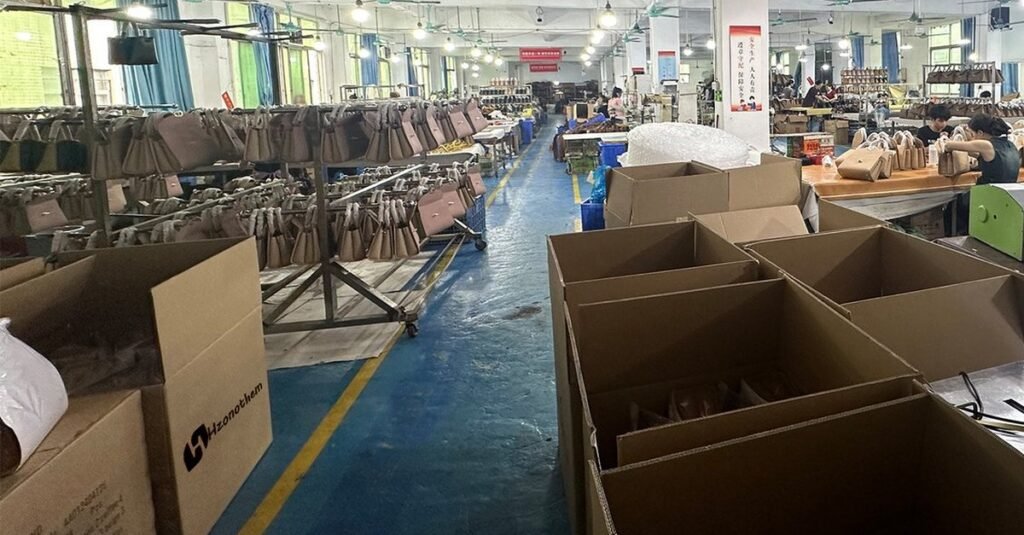
We print labels, hang tags and poly bags in-house or with our regular suppliers, apply them during packing, and include them in the pre-production sample so you approve the finished article rather than a drawing. If any of these documents are not ready, tell us at order stage — producing labels after the bags are packed is the single most common cause of a missed shipping date.
What the packaging looks like
- Each unit: PE or OPP bag, desiccant where humidity is high, hang tag attached, hardware protected with tissue. Leather bags get a dust bag as standard on request.
- Export carton: five-ply corrugated, shipping marks printed with SKU, quantity, gross and net weight, carton dimensions and country of origin. We keep carton weight within the limit your channel specifies, commonly 20-25 kg, and we drop-test the carton on request.
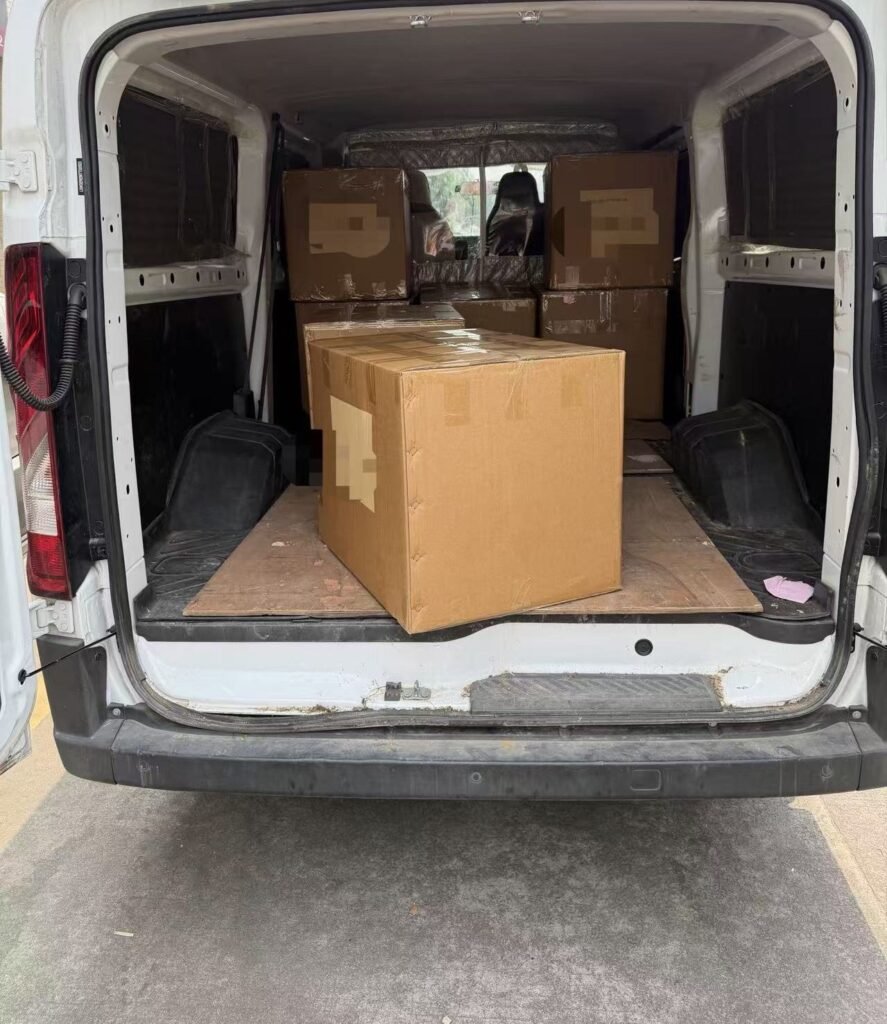
- Container loading: cartons are stacked and numbered by the loading plan, and we send photos before the container is sealed. If you are shipping to a marketplace warehouse, tell us at quotation stage — the carton and label rules are different from a retail shipment, and the difference is easier to build in than to fix.
Four mistakes we see most often
- A synthetic material labelled as leather. Almost always caused by reusing the wrong label stock, so fix the process, not just the label.
- No country of origin, or one that rubs off. A sticker on the outside of the poly bag is not a permanent marking.
- The barcode printed on the dust bag or the inside wall, where the bag itself scuffs it. Put it on the hang tag or a flat label.
- EU orders shipped without the responsible person’s details, which stops the goods at the customer’s compliance desk. Confirm these details before production, not before shipping.
Frequently asked questions
Who applies the labels, you or us?
We do. Send artwork and we print, apply and include the labels in your pre-production sample. If you prefer to label in your own warehouse, we ship unlabelled — but allow for the labour and tell us, because the cartons are packed differently.
Can you print our barcode and hang tags?
Yes. Send vector artwork with a barcode that scans at the size you need. We print in-house, and we can also source custom hang tags with your logo and finish.
Do our bags need CE marking?
No. Bags are not covered by any CE directive. What applies is GPSR and REACH in the EU, and country of origin marking plus retailer specifications in the US.
What is GPSR and does it apply to bags?
The General Product Safety Regulation (EU 2023/988) applies from 13 December 2024 to non-food consumer products, and that includes bags. The part that affects most buyers is the EU-based responsible person whose contact details must appear on the product, its packaging, or an accompanying document.
Can you send packaging weight data?
Yes. Ask for a packaging breakdown with your quotation and we will list each component with its material and weight.
Getting the labels right costs nothing at order stage
Every item on the list above is a decision you make once, before sampling, and then it is done for every future order in that style. Leaving it until the week before shipping is what turns a good order into a chargeback.
Send us your label artwork, barcode, and for EU orders the responsible person’s details with your quantity and target price, and we will come back with a costed quotation that includes labelling and packaging. You can see how that works in our guide to private label leather bags at 50, 100 and 500 pieces, or start from the complete buyer’s guide to sourcing leather bags from China.
Styles we produce under private label include tote bags, laptop backpacks, crossbody bags and purses and handbags. When the bags are ready to ship, our QC checklist explains what we check before the carton is sealed. To discuss your order, send us the details here.
If your order is going to Amazon rather than a retailer, the packing differences are in how we sample and approve a run.