A sample is the cheapest risk-reduction tool in sourcing. For the cost of one bag, you find out whether a supplier understood your brief, whether the material is what you expected, and whether the construction will survive daily use.
The problem is that samples are small work, and small work gets queued behind bulk orders. Three-week sample lead times are normal in this industry, and they are the reason many launches slip by a month or more.
Our pre-production samples take 3 to 5 days. Here is exactly what happens in that window, and what you need to prepare so the first attempt is the right one.
What we need from you before we start
A sample can only be as accurate as the brief. Send these six things and we can begin the same day:
- Photographs or a sketch of the style, showing the outside, the inside, and the base.
- Dimensions in centimetres or inches: length × height × depth. If you measured a bag you already own, tell us whether you measured it empty or full.
- Material and finish, including the leather layer if you are specifying genuine leather.
- Hardware: colour, finish and where it goes. If zipper brand matters to you, say so now rather than after.
- Your logo as a vector file, plus the placement and the method you have in mind.
- Packaging expectations, if the sample should include them.
Day 1: specification and mockup
We convert your brief into a written specification: material, thickness, hardware list, stitch density, lining, edge finish and dimensions. Where something in your brief is ambiguous, we come back with a question rather than a guess — a two-minute question now is cheaper than a remake later.
Your logo is mocked up on the actual material in the actual position. This is the fastest way to catch a problem: a foil stamp that is too fine, an embroidery that is too dense, a metal plate that sits where the bag creases.
Day 1 to 2: pattern making
The pattern is the skeleton of the bag. It determines whether the finished product matches the dimensions you specified, and whether the shape holds after use.
Working from an existing style, this stage is quick because the pattern exists and only the details change. Working from a new design, it takes longer — and this is the single biggest reason sample lead times stretch.
Day 2 to 3: cutting and stitching
Material is cut, edge-finished, and assembled. Stitch density is set to the specification agreed for your order.
This is the stage where a change of mind is expensive. If you want to adjust the proportion or the hardware after cutting, we restart from the pattern rather than unpicking a finished sample.
Day 3 to 4: hardware, logo and finish
Zippers, buckles, rings and logo applications are fitted. The interior is turned and finished. The sample is checked against the specification sheet dimension by dimension.
Day 4 to 5: photography and your approval
We photograph the sample from every angle, including any detail you asked about specifically, and send the images with a note of anything that differs from your brief and why.
That last part matters. A supplier who hands you a sample and says nothing has either not checked it or is hoping you will not notice. A supplier who flags a deviation is telling you they will do the same during bulk production.
What commonly delays a sample
| Cause | How to avoid it |
|---|---|
| Artwork arrives as a low-resolution image | Send a vector file, or ask us to convert it and approve the result |
| Dimensions given as “about the size of my last bag” | Provide actual measurements |
| Material chosen at the last minute | Choose from materials we hold, or accept the sourcing lead time |
| Logo placement undecided | Decide before cutting; moving it later means a remake |
| Feedback arriving in several messages over a week | Collect your comments and send them once |
How to evaluate the sample when it arrives
Do not just look at it. Use it:
- Put weight in it and carry it for a day.
- Open and close every zip ten times.
- Check the stitching on the seams that carry the load.
- Look at the inside, where shortcuts are visible.
- Check the dimensions against your specification.
- Ask someone who is not you to look at it and say what they notice first.
Write your feedback as a single numbered list. “Bulk order approved as sampled” and “approved with these three changes” are both fine outcomes. Silence is not.
Frequently asked questions
How much does a sample cost? It depends on the style, material and logo method. We quote it with the unit price so you can see both at once.
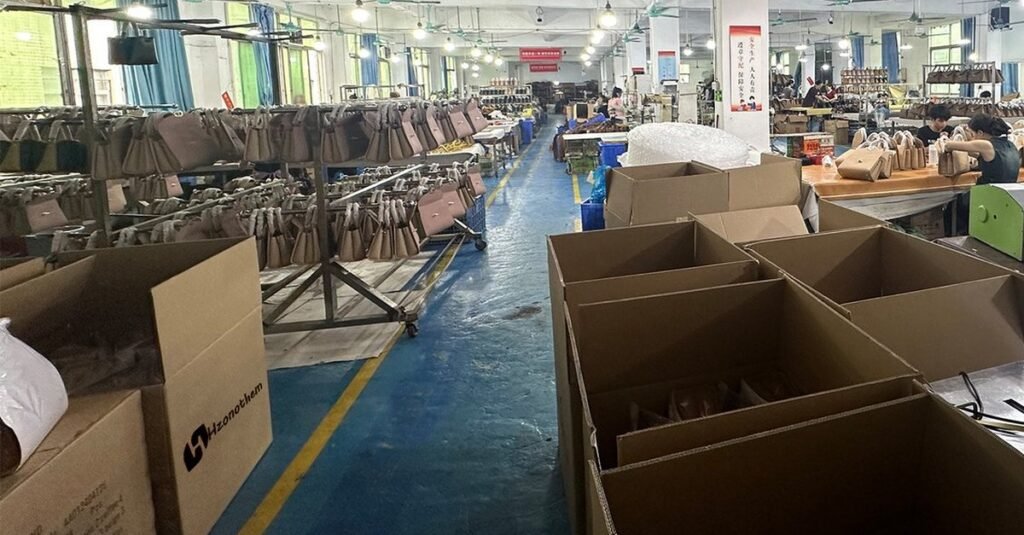
Is the sample made on the same line as bulk production? Yes, and by the same people. A sample made in a separate development workshop tells you very little about the bulk order.
Can I skip the sample and go straight to production? You can, and we advise against it. The sample costs less than remaking a production run.
What if the sample is wrong? Tell us what is wrong using the numbered list, and we revise it. If the deviation is ours, we do not charge for the remake.
How does this fit with the MOQ? The sample is produced before the order, regardless of quantity. Our MOQ is 50 pieces per style.
Send us a style and we will start the clock
Send a photo, your dimensions, your material choice and your artwork. If anything is missing, we will ask — and then the sample is usually in your hands within a week.
Browse what we already produce across laptop backpacks, tote bags and briefcases, or send your own brief.
Sampling is one stage of the process. The full sourcing guide covers what comes before and after it.
A sample can be requested on any style, including messenger bags, men’s messenger bags, fitness bags, travel duffel bags and sports mesh bags.