The unit price is the number buyers negotiate hardest over, and it is usually the smallest variable in the final landed cost. Freight, duty, packaging and last-mile can each be larger, and they are rarely discussed before the order is placed.
This guide walks through the whole cost stack, the shipping options, and the paperwork that has to line up — so the number you plan around is the number you actually pay.
The full cost stack, in order of appearance
| Cost | When it appears | Notes |
|---|---|---|
| Unit cost | At quotation | Per piece, for the specified material and construction |
| Sampling | Before production | One-off, and it protects the larger spend |
| Packaging | At quotation or later | Branded dust bags, printed cartons and inserts add up fast |
| Inland freight to port | At booking | Depends on the port and the shipment size |
| Export documentation | At booking | Usually small, occasionally not |
| International freight | At booking | The largest variable, and the one most exposed to market rates |
| Duty and taxes | On arrival | Depends on your country and the product classification |
| Customs clearance | On arrival | Brokerage, and any storage if paperwork is incomplete |
| Last-mile delivery | On arrival | Often overlooked when planning a launch |
Build a spreadsheet with all nine lines before you compare suppliers. A supplier who is three per cent cheaper per unit is irrelevant if the shipment arrives with an avoidable storage charge.
Incoterms, without the jargon
Incoterms define where the supplier’s responsibility ends and yours begins. Four cover almost every bag shipment:
- EXW — you collect from the factory. Cheapest on paper, most work for you.
- FOB — the supplier delivers to the port of departure and handles export clearance. The most common arrangement for container shipments.
- CIF — the supplier also pays international freight and insurance to your port. Simple for you, and you have less visibility into the freight cost.
- DDP — the supplier delivers to your door with duty paid. Easiest to plan, usually the most expensive line by line, and not offered by every factory.
Whichever you use, confirm it in writing on the quotation. “FOB” means nothing if neither side agrees which port.
Choosing a shipping method
| Method | Speed | Best for | Trade-off |
|---|---|---|---|
| Express courier | Days | Samples, small urgent runs | Highest cost per kilo |
| Air freight | About a week | Launch stock you cannot wait for | Expensive on bulky items |
| Sea LCL | Weeks | Small to mid volumes | Slower, and consolidated with other cargo |
| Sea FCL | Weeks | Full volumes | Cheapest per unit, and you must fill the container |
Bags are bulky relative to their value, which means you pay for volume, not weight. That single fact pushes most orders towards sea freight once the volume justifies it.
What your forwarder needs from the factory
Send this list to the factory before production ends, so nothing is discovered at the port:
- Packing list, with carton count, dimensions and weights
- Commercial invoice, with a correct description of the goods
- Carton label format — some channels and marketplaces specify it
- The HS code you are declaring
- Ready date at the factory or at the port, depending on the Incoterm
Ask for carton dimensions early. Carton size affects freight cost, and a supplier who can adjust packing to fit a container better is saving you money.
Customs and duty basics
Two things go wrong most often. The first is a vague goods description on the invoice, which delays clearance. The second is a classification that does not match the product, which can be corrected later at your expense.
Confirm the correct classification for your product and destination with your customs broker before the first shipment. It is a five-minute question with a long tail if you skip it.
Payment, and how to protect yourself
Payment terms vary, and the honest advice is to start small. A small first order limits your exposure to a supplier you have not worked with, and it tests their communication and documentation as much as their product.
Whatever terms you agree:
- Get them in writing on the quotation, including what triggers each payment.
- Ask what happens if the shipment is late or if inspection finds defects. A supplier with a clear answer has thought about it.
- Keep the paperwork complete. Incomplete documentation is where disputes start, on both sides.
Read our QC checklist for what to ask for before a shipment is sealed — the inspection report is your evidence if a problem appears after arrival.
A realistic first-import timeline
Plan in this order, and add a buffer at every stage:
- Enquiry to quote — 24 hours
- Quote approved, sample requested — 3 to 5 days
- Sample approved, production scheduled — 15 to 25 days
- Packing and inspection — before the container is sealed
- Freight and clearance — depends entirely on method
- Last-mile to your warehouse
Our lead time guide breaks each stage down further, including the causes that stretch schedules most often.
Frequently asked questions
Should I use a forwarder or let the factory arrange shipping? For a first shipment, a forwarder you chose yourself is usually better — you get direct visibility and a relationship that survives a bad shipment.
Is express shipping ever worth it? For samples, yes. For production stock, only if the cost of being late is genuinely higher than the freight.
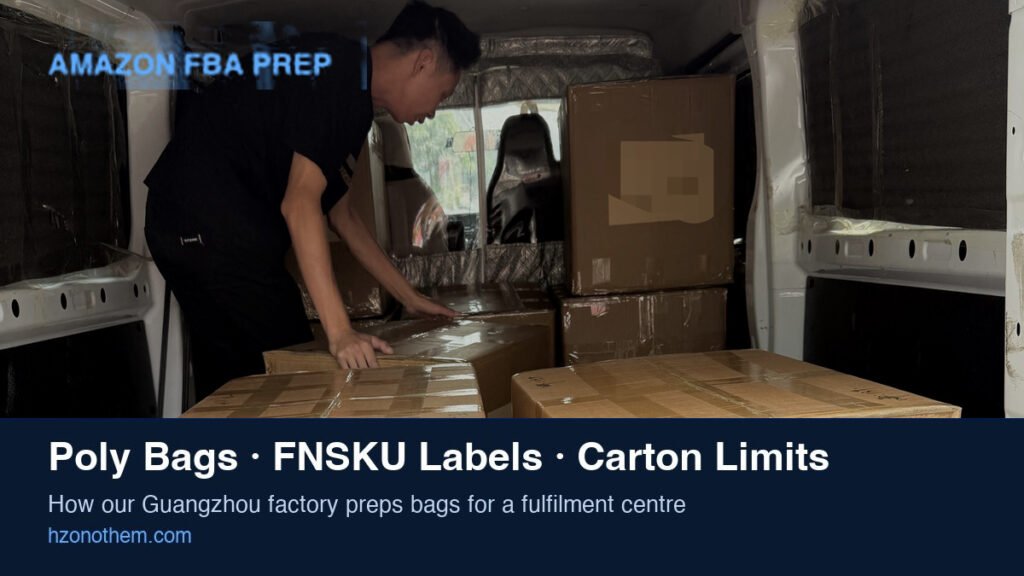
Can the factory ship to Amazon or a 3PL directly? Often yes, provided the carton labels and the packing list follow the required format. Agree the format before production, not after.
How do I know the shipping price before I order? Ask your forwarder to quote against the carton dimensions and weights from the packing list. Volumetric weight, not the scale weight, drives the price on bulky goods.
Ask us for a quote with the packing details
Tell us the styles and quantities you are considering, and we will quote the unit cost together with carton dimensions, weights and packing details, so you can get a real freight number before committing.
See our current ranges for tote bags, laptop backpacks and leather handbags, or request a quote.
For the manufacturing side that comes before shipping, see our buyer’s guide to sourcing from China.
Bulky styles are where packing efficiency matters most — see large travel backpacks, travel bags, satchel purses and straw beach totes.