Sourcing leather bags from China should be simple. In practice, most first-time buyers end up with three problems: a minimum order they cannot afford, a sample that takes a month to arrive, and no way to tell whether the supplier is a factory at all. This guide walks through every stage of the process and shows you what to ask, what to check, and what a realistic timeline looks like.
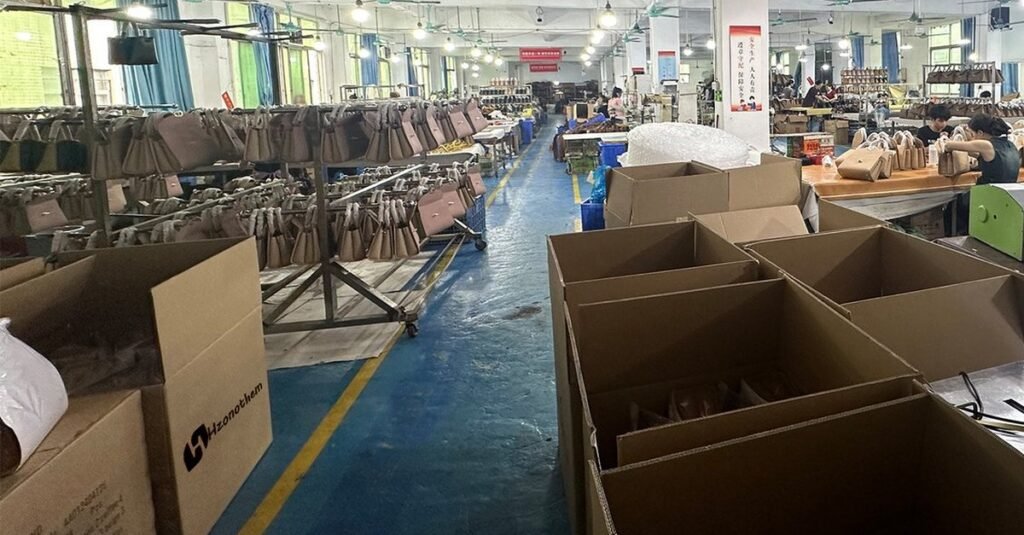
It is written by the team at HZONOTHEM, a bag factory in Guangzhou. We have been manufacturing genuine leather and microfiber bags for 20 years and have supplied more than 270 brands.
Start with the number that decides everything: MOQ
MOQ stands for minimum order quantity. It is the smallest number of pieces a factory will accept for one style. For bags made in China, MOQ usually falls between 300 and 1,000 pieces per style. That number exists for a reason: cutting dies, sample development, and production line setup all cost money, and factories spread that cost across the first order.
For a new brand or a store owner testing a new line, an MOQ of 500 is a real problem. It means paying for inventory before you know whether the style sells.
Our MOQ is 50 pieces per style. That is low enough to test a design with real customers, read the sales data, and then reorder with confidence. It is not a promotional promise — it is how we structure our production, and you can read more about what changes at different quantities in our guide to private label bag orders.
Genuine leather or microfiber? Choose by price point, not by preference
This is the decision that shapes everything downstream: your retail price, your margin, and how your product survives the first year of use.
| Material | What it is | Best for | Notes |
|---|---|---|---|
| Genuine cowhide | Full-grain, top-grain or split leather from cowhide | Mid to premium priced bags, bags that should age well | Develops a patina; needs care; heavier |
| Microfiber leather | Synthetic material engineered from microfiber, with a polyurethane finish | Entry to mid priced bags, high-volume lines, vegan ranges | Consistent, easy to clean, lighter, more predictable in production |
| PU leather | Synthetic with a polyurethane coating on a fabric backing | Very low price points | Cheaper than microfiber, less durable |
Two practical points that most importers learn the hard way:
- Thickness is not quality. A 1.2 mm top-grain leather can outperform a 1.4 mm split leather at the same price. What matters is the layer you are buying, not the millimetre.
- Always ask which layer. “Genuine leather” can mean full-grain, top-grain or a split, and the price difference is large. Ask for the exact type in writing before you approve a sample.
For a side-by-side comparison of cost and durability, see genuine leather vs microfiber.
The sampling stage: what a realistic timeline looks like
A sample is where you find out whether a supplier can actually deliver what you discussed. It is also where most delays happen, because the work is small and easy to deprioritise.
Our pre-production samples take 3 to 5 days. That pace is unusual, and it comes from keeping the sample room working continuously rather than queuing samples behind bulk orders.
Here is what to send a factory so the first sample is right:
- Clear photos of the style, inside and out
- Dimensions in centimetres or inches, length × height × depth
- The material you want, and the layer if it is leather
- Hardware colour and type (zipper brand if it matters to you)
- Your logo artwork as a vector file, plus where you want it placed
- Any packaging requirements
Then confirm these four things in writing before you approve: material specification, hardware specification, stitching density, and the exact dimensions of the finished sample.
Quality control: the numbers to ask for
Every factory says they do quality control. Ask for specifics instead.
- What is your defect rate? Ours is held under 2%. If a supplier cannot answer this question, they are not measuring.
- What do you check? Stitching density (set to your specification and measured, rather than assumed), zipper function tested across its full travel, hardware colour and coating, lining alignment, edge finish, and odour.
- Who checks it, and when? Inspection should happen during production and again at final packing, not only at the end.
- How do you pack? Bags that arrive creased or dented were packed badly, regardless of how good they were when they left the line.
Ask for a sample inspection report before your first bulk order ships. A supplier who can produce one has a process; a supplier who cannot is improvising.
Putting your logo on a bag: six options
The logo method affects your unit cost, your minimum quantity, and how the product reads in person.
| Method | Look | Works best on |
|---|---|---|
| Embossing | Subtle, tonal, pressed into the material | Genuine leather |
| Foil stamping | Metallic or matte; high contrast | Leather and microfiber |
| Embroidery | Textured, thread-based | Canvas, fabric, microfiber |
| Screen printing | Flat colour, cost-effective | Flat fabric panels |
| Metal plate | Premium, durable, precise | Any material |
| Leather patch | Handmade, artisan feel | Denim, canvas, and casual ranges |
Embossing, foil stamping, and leather patches are usually the right choices for leather bags. Send your artwork as a vector file and ask for a mockup before production — it takes minutes and prevents a costly mistake.
Packaging, cartons and loading
Packaging is where small orders and large orders differ most, and where costs hide.
Questions worth asking:
- Is a poly bag, a dust bag, or a branded dust bag included?
- What is the carton size, and how many pieces fit in one carton?
- What is the total carton volume for the order, and how does that translate into a container load?
- Can you supply the packing list in the format my forwarder needs?
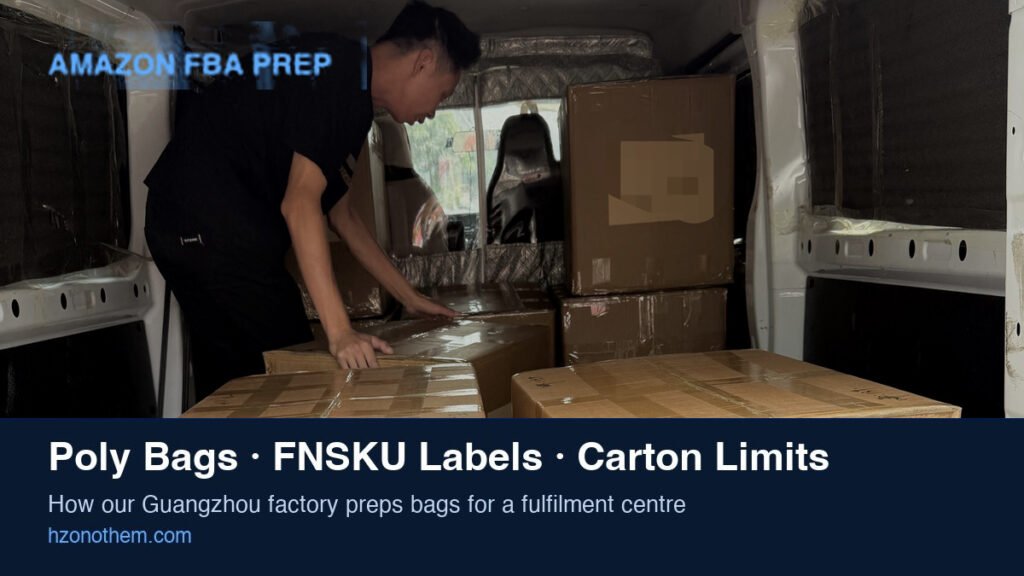
If your plan is to sell on a marketplace, ask for a carton label format that matches the platform’s requirements. Getting this wrong is one of the most common causes of receiving delays.
Lead times and how to plan a launch
A realistic schedule for a first order looks like this:
| Stage | Typical time |
|---|---|
| Quotation | 24 hours |
| Pre-production sample | 3 to 5 days |
| Sample revision, if needed | 3 to 5 days |
| Bulk production | 15 to 25 days depending on quantity and complexity |
| Inspection and packing | Included in production |
| Shipping to your country | Depends on method and destination |
Plan backwards from the date you want stock available, and add a buffer. The most common reason a launch slips is not production — it is a buyer who approved a sample late and then needed a change.
Packaging your questions for the first contact
When you contact a factory for the first time, a short, specific message gets a useful answer. Include:
- The style, or a photo of something close to it
- Quantity you want to start with
- Whether you need your logo on it
- The country you will ship to
That is enough for an accurate quote. Vague enquiries get vague answers from every factory, including the good ones.
How to tell whether you are talking to a factory
This deserves more space than a paragraph, so we wrote a separate guide: how to tell if a bag supplier is a factory or a trading company. The short version is that you should ask for a live video call in the workshop, ask technical questions that only someone who runs production can answer, and check whether the business licence scope matches what they claim to make.
Frequently asked questions
What is your minimum order quantity? 50 pieces per style, in one colour.
How fast can I get a sample? Pre-production samples take 3 to 5 days once we have your specifications and artwork.
Do you make both genuine leather and microfiber bags? Yes. We produce genuine cowhide and microfiber leather ranges, plus canvas and oxford styles.
What is the warranty? Every bag we manufacture is covered against defects in workmanship and materials for three years from the date of purchase.
Can I put my own logo on the bags? Yes. Embossing, foil stamping, embroidery, screen printing, metal plates and leather patches are all available.
What do you need from me to quote? A photo or description of the style, your quantity, whether you need branding, and your destination country. We reply within 24 hours.
Talk to us about your first order
If you are testing a new style, or moving production to a factory that will answer these questions properly, send us a photo and a quantity. You will get a price within 24 hours, and a sample in 3 to 5 days.
Browse our current ranges — leather handbags, tote bags, laptop backpacks, messenger bags and briefcases — or get a quote and tell us what you need.
Our current leather ranges include genuine cowhide handbags, large leather backpacks, cowhide backpacks and handmade leather satchels.
If you are sorting out labels and packaging at the same time, our guide to bag labeling and packaging requirements for US and EU retailers covers what has to appear on the product, what US and EU channels ask for, and what we need from you to print it.
In the leather line we also produce retro crazy horse leather chest bags.
If you want the detail behind any step, we keep it in separate guides: what MOQ means and how 50-piece orders work, OEM vs ODM, our 3-5 day sample process, lead times, the QC checklist and what drives unit cost.
On the commercial side: import costs, shipping and payment and Amazon FBA packing. Three client stories if you want the practical version: a US brand growing from 30 to 400 pcs, a Japanese client from 50 to 300 and school backpacks for Amazon.
If you already know the style you need, each product line has its own sourcing page: totes and satchels, work totes, laptop totes, briefcases, backpacks, travel backpacks, waist packs and chest bags.